I’ve spent a lot of time reading hot takes on what AI is going to do over the next few years.
Most of it falls into one of two camps: either everyone’s going to lose their jobs, or AI is going to usher in some golden age of prosperity. Neither one describes what I’m actually seeing, and I’ve been trying to put my finger on why.
None of the takes seem to address the actual mechanics of how this is playing out at the individual level, on the field, between three distinct groups of players.
Before I get into the mechanics, let me define the players.
In every company, there are (1) generalists and (2) specialists. The generalist is the person who knows a little about a lot. This is the CEO who can talk product, finance, marketing, and engineering in the same meeting, or the founder who writes the pitch deck, reviews the contract, and mocks up the landing page all in the same week. They’re usually not the best at any one thing, but they understand how all the pieces fit together.
The specialist is the opposite. They know everything about one thing. This is the designer who can tell you why that button is 2 pixels too far left, or the tax attorney who knows the exact IRS ruling that applies to your specific situation. They’ve spent years going deep in a single domain.
Then there are (3) the labs — companies like OpenAI, Anthropic, and Google that build the AI models themselves. They’re the ones releasing ChatGPT, Claude, Gemini, and the other tools that both generalists and specialists are now using. Think of them as the arms dealers — they supply the weapons, and everyone else fights with them.
With those three groups in mind, let me take a stab at describing three distinct phases that I think play out over the next ~three years.
We’re in the first one right now.
Phase I (Now + Next 18 Months): The Rise of the Generalists
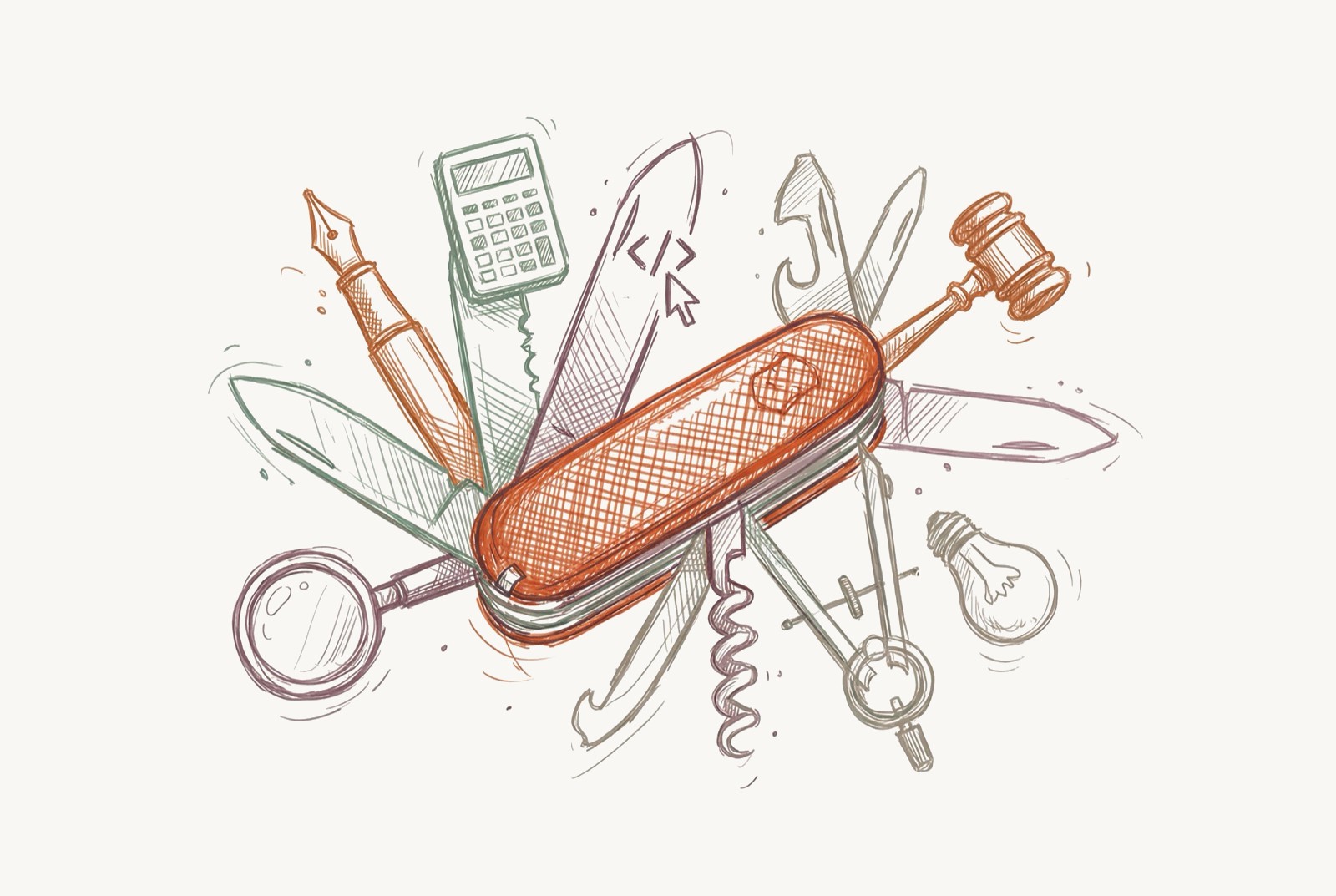
If you spend any time at all on X, you’ve seen the posts from the generalists. These are mostly founders like me who have turned into full-throated AI zealots because they wake up every day and can’t believe their luck.
I’ve been using Claude Code for 72 hours straight and you won’t believe that I just did ___.
They’re building landing pages in hours. Drafting pitch decks in minutes. Prepping for board meetings with voice dictation. Writing legal docs that are actually good.
All without calling in a single specialist to help.
But this makes sense when you back up and think about who these people usually are. These are people who’ve always been able to effectively direct work across half a dozen different areas, but usually had to delegate the actual execution of the work.
As AI has collapsed the gap between vision and execution, the generalists have been the best positioned to exploit it.
Again, I want to be clear about what I mean by “generalist.”
When I say “generalist,” I don’t mean pure middle managers with no real execution skills . I’m not talking about people throwing a prompt into Claude and thinking they can vibe-code a production app.
I’m talking about people who truly understand the fundamentals of many domains — finance, legal, product, engineering, marketing — and have an intuitive sense for the Pareto principle (the 80/20 rule) within each one.
They know that 20% of the effort gets you 80% of the result, and more importantly, they know which 20%.
In other words, to be a legit generalist, first-principles knowledge is a prerequisite.
I keep coming back to a basketball metaphor.
A center has a natural advantage in basketball — height. But that advantage has historically come with trade-offs. Centers historically couldn’t dribble or shoot like a point guard.
Now imagine you gave every 7-footer in the NBA 90% of the best point guard’s ball-handling and passing skills overnight. Not 100% — but enough that the positional lines start to blur.

It’s not obvious anymore why you need five distinct positions when the center can bring the ball up the court, run a pick-and-roll, and hit an open three at a reasonable clip.
That’s what AI has done for generalists. It has given them 90% of the specialist’s execution ability in every domain they already understood conceptually. And 90% turns out to be a lot.
Take the landing page as an example. Everybody remembers when AI first started making landing pages.
They were incredible for the fact that AI was making them at all — but they lacked taste.
Purple gradients everywhere. The same three fonts. No soul. The gap between “AI made this” and “a designer made this” was obvious to anyone with a decent eye.
But as a generalist who wanted to harness this new capability, I started trying to close the gap.
I got better at prompting — that helped, maybe 5%. I found a front-end design skill plugin (essentially a file that packages a real designer’s taste and judgment into instructions an AI can follow) — another 5–10%.
I noticed the animations still felt generic, the components not quite unique enough, so I found some UI component libraries and had Claude refine things further. Another few percent.
Each refinement got me a little bit closer, and all the while the underlying AI models were improving as well. Eventually, I could work with Claude to build a landing page and be genuinely blown away: a complete, functional, world-class, deployed page.
The difference between this landing page and the best landing page in the world? Pretty marginal.
The amount that a generalist can accomplish in February of 2026 is astounding, and the result is a power shift that is already underway.
In the labor market, we’re in the early innings of a tilt toward generalists and away from specialists — most visibly so far in copywriting, software development, customer support, and design.
So where are the specialists in all of this?
It’s not that they’re sitting it out. The leading-edge specialists are already experimenting. Some of them are already feeling the FOMO. They see what generalists are posting on X, and they can tell the gap is closing.
But for the majority? Their deeply embedded workflows still get them the 100% output they’re looking for. The raw AI output — the stuff they see out of the box from Claude, Gemini, etc. — genuinely isn’t good enough for them.
A great designer looks at what Claude produces and thinks, “this isn’t even close to my best work.” A financial analyst reviews an AI-generated pro forma and spots a dozen errors or things they’d do differently. The base output might hit 80% of the specialist’s standard, and that remaining 20% is exactly what they’ve spent years mastering. So they dismiss it.
What most of them haven’t fully reckoned with yet is what happens when a generalist who understands first principles gets their hands on the raw output. The generalist doesn’t just accept the 80% — they shape it, prompt it, refine it, push it to 90 or 95%. And suddenly the gap between “AI output” and “specialist output” isn’t as obvious.
And the generalist starts asking: is that last 5% really worth paying a specialist for?
I’ve seen this over and over for the last 18 months. Show AI-generated code to engineers — “not as good.” Show AI-generated designs to designers — “not as good.” And they’re not wrong. But they’re evaluating the base model, not what a skilled generalist can coax out of it.
My guess is that it will be this way for another 18 months before this fully plays out and the next phase takes over.
Phase II (18–36 Months): The Specialists Strike Back, aka The Return of Comparative Advantage

Back to the landing page example for a second.
My Claude-collab pages may have gotten pretty good, but still, if I look at them next to the best landing pages in the world, I notice the gaps. They might just be a pixel here, a subtle typography issue there, the way the eye moves through the page, etc., but they’re there.
And here’s the thing. I don’t just need one great landing page. I end up needing an entire site map of a dozen pages. And they all have to maintain consistent styling, copywriting, etc.
And that style has to cascade into my product. And into my email. And into my social.
That’s where I start to feel the limits.
Even with AI getting me 95% of the way there 10x faster than before, closing that last 5%, scaling it, and maintaining it still requires me to become more of a specialist.
And as a generalist, I just don’t have the time for that. I may only have Monday for the landing page. Tuesday is the marketing campaign. Wednesday is sales. Thursday is legal and compliance.
That’s the generalist’s life. I’m 10x more productive than I used to be, but I’m still spreading myself across everything.
Once the generalists find where the sidewalk ends, I think we all rediscover the first principle of comparative advantage.
The generalists may start out ahead and get pretty far with their natural proclivity for AI and early adoption, but eventually the specialists catch up.
The designer eventually embraces the same AI tools I’m using and spends Monday through Friday on nothing but design. And that last 5%? It’s not hard for her to spot it and address it because she already understands it deeply.
She builds 15 landing pages in a week. She figures out how to create and maintain entire design systems using AI. She develops workflows and prompt patterns that consistently produce output at a level I can’t reach, because she can see things I can’t see and ask for things I don’t know to ask for.
The specialist armed with AI in their domain will eventually be more effective than the generalist armed with AI across all domains.
And when they respond, I think the benchmark for what “great” looks like resets entirely. Today’s best landing page was probably made by a designer using Figma or Framer, no AI.
Over 18 months, generalists using AI will produce work equivalent to today’s best. But by then, the new best will be whatever specialists-plus-AI are creating — probably something we can’t even imagine right now.
The bar will keep moving, and the specialists will be the ones moving it.
In other words, the point guard asks: “what do I do when the center can handle the ball?”
The answer: get really good at something the center still can’t do. And there’s always something.
Phase III (all along the way): The Deflationary Squeeze
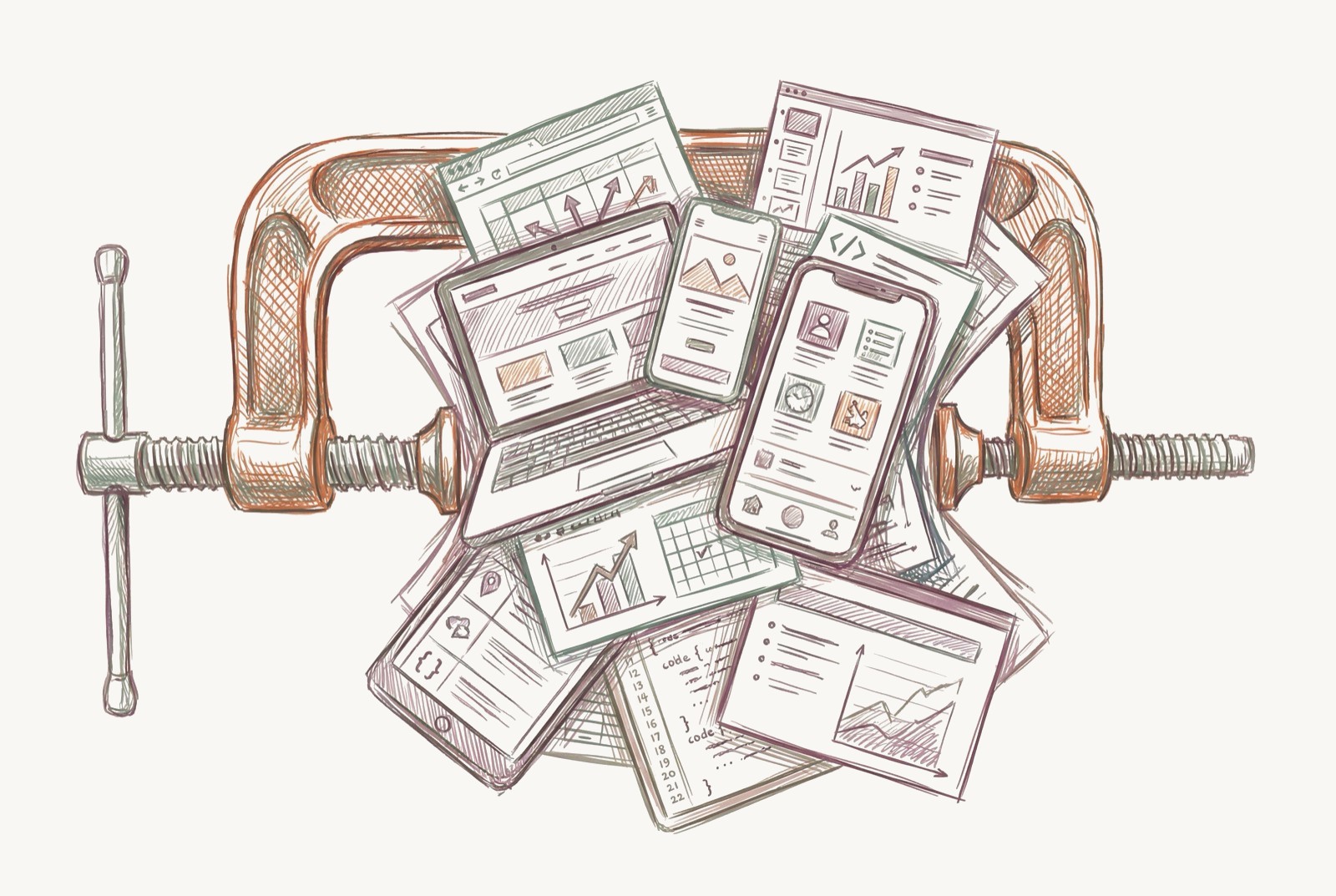
Here’s where it gets uncomfortable for everyone.
In the old world, a generalist who needed a one-off landing page hired a designer. That cost maybe $2k. In Phase 1, the generalist looks at that and thinks, “I just replaced $2k with a $20/month Claude subscription.”
In Phase 2, the specialist reclaims the quality edge. The generalist goes back to hiring a specialist whenever they need that last 5–10% — just like before.
Comparative advantage may have won again, but the specialist’s economics have changed forever.
What used to take two days now takes two hours. They can charge a premium over the generalist’s output, sure. But they can’t charge the old premium, because every other specialist with the same depth is also producing at 10x speed. The supply of “world-class” work has exploded. Pricing compresses.
This is what I think Phase 3 looks like: everyone — generalist and specialist alike — is arbitraging on top of the same underlying models. The model is the commodity. The human layer is the margin. And as the models get better, that human layer gets thinner.
The specialist still has more margin than the generalist in their domain. But I think both are on a downward slope.
The Skill File Ratchet
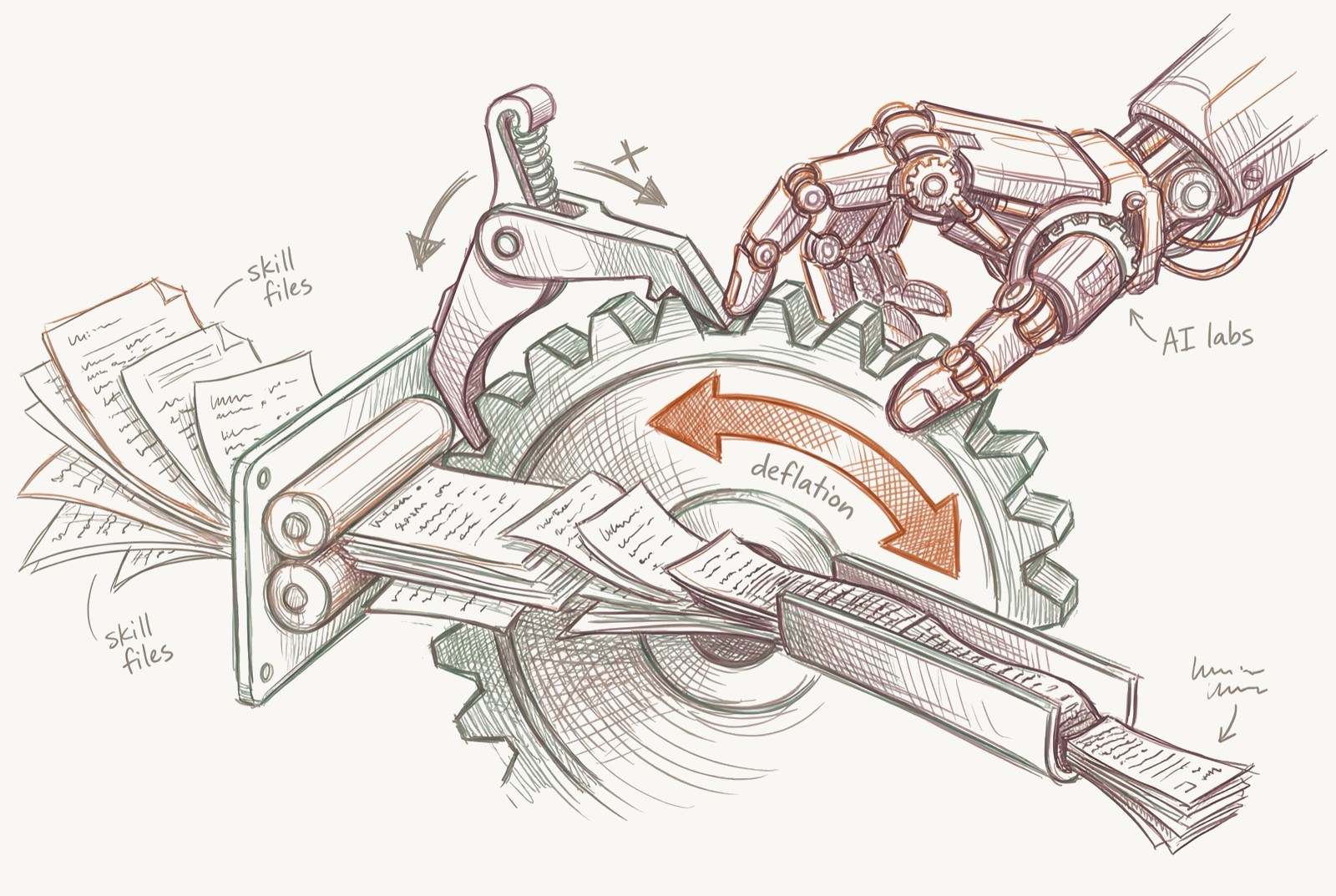
There’s a mechanism that I think makes this deflationary pressure structural, not just competitive.
Remember those design skill plugins I mentioned earlier — the ones that helped close the gap between AI slop and real design?
What actually happened there?
Someone took a designer’s judgment and packaged it into a “skill file” that any generalist could install. The generalist didn’t actually get any better at design — they just plugged in someone else’s taste.
In the old world, a specialist’s knowledge was locked inside their head. It took years to develop and was incredibly difficult to transfer.
Even when a world-class designer posted YouTube tutorials showing their exact workflow, the generalist still had to invest dozens of hours watching, practicing, and failing before they could even begin to approximate the output.
The transfer cost of human skills was a huge moat for people in the labor market. The emergence of skill files obliterate that transfer cost:
- A specialist builds a library of prompt patterns, workflows, and context engineering systems to get AI output that meets their standards.
- They publish it on GitHub.
- A generalist says “hey Claude, install this skill.”
- They’re instantly upgraded even during cycles when the underlying AI model didn’t improve.
The friction of skill transfer goes from years of studying and failing to one prompt in the command line.
So why do the specialists keep open-sourcing their knowledge like this? Because the incentives are too strong not to.
Specialists who publish skill files and plugins gain reputation, followers, community, etc. Enough specialists find it worthwhile to share their hard-won intuitions and workflows for free that there’s a constant stream of new skills flowing into the ecosystem every day.
Sometimes, the specialists who are releasing these files are even employed by AI labs, and so the release of their skills is a net-gain for the lab’s brand without threatening the specialist livelihood (for now).
So the specialist faces a double squeeze. From above, the labs keep improving the base models and shipping their own skill files. From the edges, other specialists keep externalizing their domain knowledge into transferable packages.
The differentiation layer doesn’t just get competed away by other specialists — it gets packaged and distributed to everyone, instantly.
This is a one-way ratchet that continually closes the distance between generalist output and specialist output and fuels the overall deflationary force.
So, What Holds Value?
The natural question is: so what holds its value when all of this plays out?
I don’t have a good answer yet.
The obvious ones — relationships, taste, trust, distribution — are probably true, but they’ve been said before, and I don’t think I have a unique perspective on that part of the problem today.
What I do think I have is a useful framework for the mechanics — the part I felt was missing from the conversation.
Generalists move first, specialists reclaim the quality edge, but all the while deflationary pressure squeezes everyone, accelerated by the fact that specialist knowledge keeps getting packaged into instantly transferable files.
I think that’s the shape of the next ~three years.
When I talk about the timelines of these phases, I want to be clear: I’m talking about how long it takes for these waves to wash over the majority of knowledge workers, not the leading edge. The bell curves overlap. Some specialists are already adapting and some generalists are falling behind. I’m attempting to describe when the center of the bell curve moves.